IT environments are growing faster than most operations teams can handle. More applications, monitoring tools, and incidents often lead to one outcome: reactive firefighting.
For organizations running on ServiceNow, AIOps (Artificial Intelligence for IT Operations) offers a practical way to break that pattern. It brings operational data, analytics, and automation onto a single platform, so teams can spot issues earlier, cut alert noise, and resolve incidents with more context.
In this blog post, we will look at how ServiceNow AIOps, delivered by inMorphis, makes IT operations more stable, predictable, and service‑oriented.
What is AIOps in a Modern ServiceNow IT Operations Environment?
AIOps pulls together data from logs, metrics, events, and tickets, then applies analytics and machine learning on top of it. On ServiceNow, AIOps is tightly integrated with:
- IT Operations Management (ITOM) – discovery, service mapping, event management.
- IT Service Management (ITSM) – incidents, problems, changes.
- CMDB – configuration items (CI) and their relationships.
In this environment, AIOps helps IT teams to:
- Detect anomalies early, before they cause outages
- Correlate related events into a single, meaningful incident
- Identify likely root causes using service dependency maps
- Identify emerging capacity or performance risks based on historical patterns and trends.
inMorphis designs AIOps / Artificial Intelligence for IT Operations solutions so that AIOps understands your actual business services, not just isolated infrastructure components.
For a more detailed explanation of AIOps and AI‑driven IT operations, see The Ultimate Guide to AIOps: AI‑Driven IT Operations
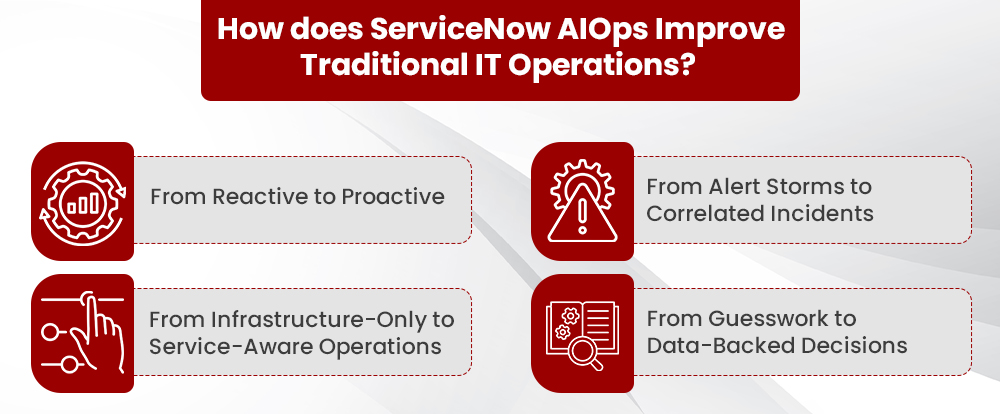
How does ServiceNow AIOps Improve Traditional IT Operations?
In many organizations, IT operations still depend on manual monitoring, separate tools, and reactive responses. Even with modern platforms in place, teams work in silos and usually act only after incidents impact users.
ServiceNow AIOps changes this operating model in a few concrete ways, which are as follows:1
From Reactive to Proactive
- AIOps searches for anomalous patterns in metrics and logs instead of waiting for alarms to spike.
- These early warnings give teams time to respond before SLAs are at risk.
From Alert Storms to Correlated Incidents
- Multiple alerts from different tools are grouped into one correlated incident.
- Teams address the underlying issue instead of individual symptoms.
From Infrastructure-Only to Service-Aware Operations
- With CMDB and service mapping, AIOps understands which business services are affected.
- IT can prioritize incidents based on business impact.
From Guesswork to Data-Backed Decisions
- AIOps analyzes past incidents and patterns to suggest likely contributing components and probable causes.
- Teams spend less time testing hypotheses and more time applying proven fixes.
This shift aligns well with organizations that already use ServiceNow ITSM and ITOM and want to unlock more value from their existing investments.
How Does ServiceNow AIOps Deliver Tangible Value to Your Operations?
ServiceNow AIOps delivers value when it is applied to clear, day‑to‑day IT operations scenarios. Some of the most impactful uses cases include:
Noise Reduction and Intelligent Incident Creation
- Events from multiple monitoring tools are ingested into ServiceNow Event Management.
- AIOps correlates them into fewer, richer incidents in ITSM.
- Each incident contains context such as affected CIs, impacted services, and probable causes.
Early Anomaly and Performance Detection
- AIOps detects anomalies in usage, errors, or latency trends.
- Issues are flagged before users report problems, reducing unplanned downtime.
Accelerated Root Cause Analysis
- Using service mapping and the CMDB, AIOps highlights the components most likely responsible.
- Teams focus on a narrowed scope, reducing Mean Time to Resolution (MTTR).
Capacity and Resource Forecasting
- Historical patterns allow AIOps to forecast capacity or performance bottlenecks.
- IT can plan scaling or optimization activities instead of reacting to failures.
Smarter Incident Communication
- With ServiceNow GenAI capabilities (such as Now Assist), incident data and AIOps insights can be summarized for quicker understanding.
- Stakeholders receive clearer, more consistent updates with less manual effort.
inMorphis aligns these use cases with each client’s IT operations model so adoption is practical and outcomes are measurable.
How Does inMorphis Implement ServiceNow AIOps?
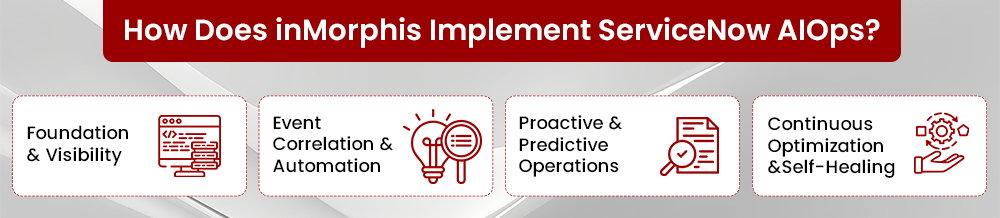
AIOps adoption is most effective when approached as a phased journey rather than a one-time deployment. A typical roadmap with inMorphis includes:
Stage 1 – Foundation and Visibility
Objective: establish a single, reliable operational view.
- Assess and strengthen the quality of CMDB data and relationships.
- Implement or refine discovery and service mapping.
- Integrate key monitoring tools with ServiceNow Event Management.
Stage 2 – Event Correlation and Automation
Objective: reduce manual triage and improve first-level response.
- Configure AIOps for event correlation and noise reduction.
- Automate incident creation and enrichment in ITSM.
Stage 3 – Proactive and Predictive Operations
Objective: identify and act on risks before they affect services.
- Enable anomaly detection and forecasting features.
- Incorporate GenAI selectively for summaries, recommendations, and knowledge usage where relevant.
Stage 4 – Continuous Optimization and Self-Healing
Objective: embed AIOps as a steady, dependable capability.
- Add controlled automation for standard remediation tasks.
- Refine models and rules based on real incident history.
- Build service health dashboards that reflect IT and business impact.
- Throughout these stages, inMorphis supports configuration, testing, adoption, and ongoing ServiceNow Support, ensuring
- AIOps remains aligned with operational needs.
What AIOps Challenges Can inMorphis Help You Overcome?
Common challenges in AIOps and ServiceNow AIOps adoption include:
1) Data and CMDB Issues
Incomplete or inaccurate CMDB data leads to weak AIOps correlations and incorrect impact analysis.
inMorphis focuses early on discovery, service mapping, and CMDB clean-up so AIOps runs on reliable, up-to-date information.
2) Tool and Data Fragmentation
Multiple unintegrated monitoring and logging tools create blind spots for AIOps.
inMorphis helps consolidate and integrate key data feeds into ServiceNow, providing AIOps with a complete view of your environment.
3) Limited Trust in AI-driven Recommendations
Operations teams hesitate to rely on AI when they cannot see how it works.
inMorphis designs AIOps rules and workflows with clear logic, transparent criteria, and gradual automation to build confidence over time.
4) Risk of Over-Automation
Direct auto-remediation without governance can introduce new operational risks. inMorphis combines AIOps with Governance, Risk, and Compliance (GRC) practices and introduces automation in stages, with appropriate approvals and controls.
By addressing these areas, inMorphis helps enterprises adopt AIOps on ServiceNow in a structured, low-risk way and steadily increase trust in automation.
When Should You Consider Implementing ServiceNow AIOps?
ServiceNow AIOps becomes a strategic priority when:
- Incident and alert volumes are consistently high across multiple tools.
- NOC and IT operations teams spend most of their time on manual triage.
- Your environment spans data centres, cloud, and SaaS, making end‑to‑end visibility difficult.
- ServiceNow ITSM/ITOM is in place but mainly used for reactive ticketing.
- Business stakeholders expect higher availability, tighter SLAs, and clearer reporting on IT impact.
For a detailed comparison, you can also refer to ServiceNow AIOps vs Traditional IT Operations: Which Delivers Better Results?
Ready to Adopt ServiceNow AIOps?
AIOps on ServiceNow is no longer an option; it's a strategic imperative for modern IT. It shifts operations from reactive to proactive, reduces noise, and accelerates incident resolution, directly impacting your business's efficiency and resilience.
inMorphis brings deep ServiceNow expertise, proven AIOps implementation strategies, and a focus on tangible outcomes. We help you build a robust, intelligent IT operations framework that delivers real value.
Contact inMorphis today to schedule a consultation and discover how ServiceNow AIOps can redefine your IT operations.
Reference:
