
Could your service operations use a smarter, faster approach to field service management? Field service is today a critical function that directly affects revenue, customer retention, and brand reputation. Missed deadlines, repeat visits, and fragmented workflows increase costs and reduce competitiveness. Enterprises managing distributed assets, global workforces, and complex service networks cannot rely on manual scheduling or disconnected tools. What’s needed is an intelligent, connected platform that manages the entire service lifecycle in real time.
ServiceNow Field Service Management (FSM) brings that vision to life. Built natively on the Now Platform, it unifies work order creation, intelligent scheduling, mobile field enablement, and performance analytics into one seamless workflow. ServiceNow FSM transforms field service into a board-level capability, optimizing workforce utilization, reducing downtime, and enabling predictive operations that protect revenue and strengthen customer trust.
This blog explores how ServiceNow FSM operates, its advanced features, the tangible benefits it delivers, and how organizations, such as a global printing and digital solutions leader, transformed their service delivery using this platform.
What is ServiceNow FSM (Field Service Management)?
ServiceNow FSM (Field Service Management) is a cloud-native, workflow-driven application that coordinates every stage of a field service job, from the initial trigger to post-service analysis, all within the ServiceNow Now Platform. It serves as the central hub connecting service requests, asset data, technician resources, and customer communication in real time.
Let’s take a lifecycle example on how ServiceNow FSM handles a real-world scenario:
1. Trigger: The service workflow starts when an event occurs, such as:
- A CSM case logged for a failed customer network router.
- An ITOM event detects critical server overheating.
- A preventive maintenance schedule identifying an industrial pump due for inspection.
- An IoT sensor alerts of a potential manufacturing machine failure.
Each of these inputs automatically creates a work order in FSM, linked to the relevant Configuration Item (CI) in the CMDB.
2. Plan: ServiceNow FSM’s AI-driven scheduling engine evaluates technician skill profiles, location, SLA deadlines, and spare parts availability.
Example: For a telecom tower antenna repair, FSM assigns a certified technician, confirms part availability in a nearby warehouse, and books the earliest SLA-compliant slot.
3. Execute: The assigned technician uses the ServiceNow Mobile Agent App on-site.
- They see the job details, asset history, and safety checklists.
- GPS tracking confirms arrival time.
- Offline mode ensures they can still capture data, take photos, and log repairs even in non-network zones; the system syncs once connectivity returns.
- AI guidance (via Now Assist) suggests possible fixes based on similar past incidents.
4. Close and Analyze: Upon service completion, the technician records details and secures the customer’s digital signature. FSM then:
- Technician logs completion details and captures customer’s digital signature.
- ServiceNow FSM automatically updates the CMDB with the new asset condition and repair history.
- If the service was billable, it pushes the data to the ERP system for invoicing.
- Performance dashboards show metrics like time-to-fix, parts used, and SLA compliance, helping managers refine future operations.
Also, read Top 5 Must Have ServiceNow Developer Skills
What are the Key Features of ServiceNow FSM for IT Enterprises?
ServiceNow FSM is built on an adaptable framework that blends AI, automation, and platform-native workflows. These capabilities enable faster decision-making, higher first-time fix rates, and more predictable service delivery. Below are the core technical strengths:
1. Now Assist with Generative AI Support
ServiceNow has embedded Generative AI that leverages vector search across the knowledge base, service manuals, and historical job records to surface the most relevant insights for technicians. It supports natural language queries like “Show me the last three breakdown reports for this model” and can auto-generate:
- Work order summaries post-completion.
- Recommended next steps based on similar past incidents.
2. AI-Powered Scheduling Optimization
The dynamic scheduling engine runs a multi-variable constraint solver that evaluates:
- Technician skill matrix
- Current and projected travel times (via map API integrations)
- SLA breach probability
- Inventory lead times
If availability changes mid-shift, the engine rebalances assignments in real time to avoid delays.
3. Field Service Marketplace and Contractor Management
ServiceNow FSM can extend capacity by onboarding third-party contractors directly into its workflows as extended workgroups. The system enforces service quality by:
- Tracking SLA metrics for external partners.
- Applying automated vendor scorecards.
- Managing performance contracts within the platform.
4. Unified Mobile Agent Experience
The offline-first mobile framework ensures technicians can operate in low-connectivity areas. Key mobile agent capabilities include:
- Delta sync for minimal data usage.
- Barcode/QR scanning for asset verification.
- GPS-based geofencing to confirm arrival and time-on-site.
5. Dispatcher Workspace and Territory Planning
The dispatcher’s interface, built on Agent Workspace, uses live map layers to display technician locations and active job clusters. Territory mapping is powered by:
- Polygon-based service zones.
- Dynamic load-balancing rules to prevent technician overload.
6. Predictive Intelligence and Preventive Maintenance
By analyzing telemetry from IoT/OT devices, FSM’s regression models predict mean-time-to-failure for equipment. This enables:
- Automatic creation of preventive maintenance tasks.
- Scheduling during low-impact time windows to reduce downtime.
7. Multi-Day Tasks and Task Bundling
FSM supports dependency-based sequencing for complex jobs. For example, electrical inspections must be completed before HVAC installation begins. Bundled tasks share:
- Resource reservations.
- Equipment scheduling to avoid conflicts.
8. Virtual Agent and Self-Service
Built-in NLP models interpret customer or technician queries and automatically route them to the correct workflow. Supported channels include:
- Microsoft Teams
- Web self-service portals
9. Performance Analytics and Process Mining
ServiceNow FSM process mining capabilities highlight systemic issues such as approval delays or frequent part shortages, allowing for targeted operational improvements. Real-time dashboards track:
- SLA adherence
- First-time fix rate (FTFR)
- Technician utilization
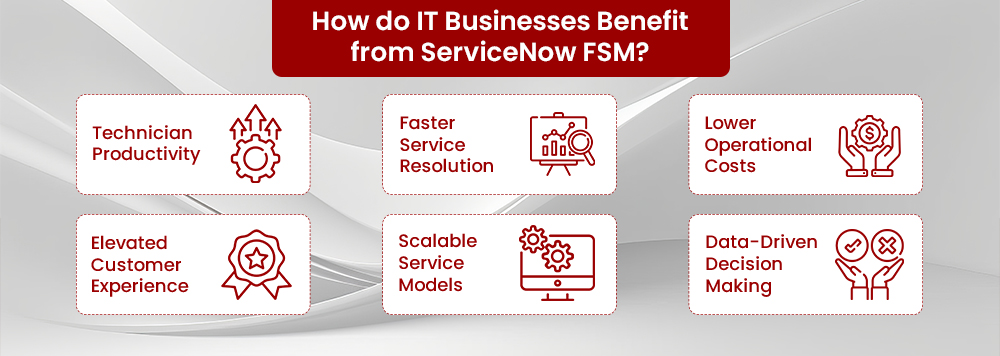
How do IT Businesses Benefit from ServiceNow FSM?
ServiceNow FSM improves field operations by combining AI-driven scheduling, IoT/ITOM integrations, and real-time analytics into a unified platform. These capabilities translate into measurable operational, financial, and customer experience gains.
1. Technician Productivity
By eliminating manual scheduling errors through AI optimization, technicians receive the right job details, asset history, and required parts before arriving on-site. This reduces back-and-forth trips and increases the likelihood of resolving issues on the first visit.
2. Faster Service Resolution
- Integration with ITOM and IoT enables automated creation of work orders from alerts or sensor data, reducing the time between fault detection and dispatch.
- Mobile AI assistance provides contextual guidance and step-by-step troubleshooting, helping technicians diagnose and resolve issues more efficiently.
3. Lower Operational Costs
- Route optimization features reduce travel distance and time, lowering fuel usage and vehicle wear.
- Integrated inventory checks ensure parts are sourced before dispatch, avoiding costly emergency procurement.
4. Elevated Customer Experience
- Real-time status updates, including technician location and estimated arrival time, increase transparency.
- Customers can receive proactive notifications about delays, rescheduling, or parts availability through self-service portals and messaging channels.
5. Scalable Service Models
- The Field Service Marketplace allows seamless onboarding and management of third-party contractors while maintaining SLA visibility.
- It supports large-scale operations with thousands of concurrent mobile agents.
6. Data-Driven Decision Making
- Role-based dashboards provide KPIs such as SLA compliance, first-time fix rates, and technician utilization.
- Process mining identifies workflow inefficiencies, enabling targeted improvements across field operations.
Case Study: Transforming Field Service Delivery with ServiceNow
A global leader in printing and digital solutions firm1 was facing challenges with fragmented field service operations, skill gaps in its workforce, and increasing customer expectations. The company aimed to unify service teams, improve resolution times, and enhance customer experience while reducing operational costs and carbon footprint.
Challenges
- Disconnected field support teams with inconsistent processes and service quality.
- Manual, inefficient workflows causing delays in issue resolution.
- Knowledge loss risk due to retirement of highly experienced technicians.
- Limited ability to diagnose and resolve issues remotely, leading to unnecessary truck rolls.
- Rising operational costs and environmental impact from excessive travel.
Solutions
1. Unified Field Service Operations
Implemented ServiceNow FSM and CSM to standardize workflows, integrate performance analytics, and improve real-time visibility into operations.
2. Augmented Reality and AI-Driven Support
Integrated CareAR for AR-powered remote assistance, enabling experts to visually guide technicians and customers, reducing repeat visits and accelerating skill transfer to new hires.
3. Data-Driven Optimization
Leveraged analytics to reduce travel time, optimize scheduling, and track resolution performance. AI recommendations helped technicians proactively address potential issues.
4. Knowledge Retention and Upskilling
Used AR collaboration and ServiceNow’s knowledge base to capture expert know-how and deliver step-by-step guidance, bridging the experience gap for early-career technicians.
Benefits
- 1,227 metric tons reduction in carbon emissions in 24 months through fewer truck rolls.
- 53 minutes of additional productive repair time per technician per day.
- 10% improvement in remote resolution rates with AR-powered support.
- 50% reduction in repeat service visits, cutting costs and downtime.
- Improved workforce readiness by accelerating onboarding for new technicians.
Conclusion
ServiceNow FSM (Field Service Management) is a fully integrated, AI-driven orchestration layer for modern field operations. By unifying work order creation, dynamic scheduling, mobile enablement, and performance analytics on a single platform, FSM eliminates the silos that traditionally slow down service delivery.
In an era where customer expectations are shaped by real-time transparency and zero-tolerance for downtime, it provides the agility and intelligence enterprises need to stay ahead. Whether its predictive maintenance triggered by IoT sensors, AI-assisted troubleshooting in the field, or seamless scaling through contractor marketplaces, ServiceNow FSM enables enterprises to move from reactive fixes to proactive, data-driven service strategies. The result is a consistently higher first-time fix rate, stronger customer relationships, and a more resilient, future-ready service model.
At inMorphis, we specialize in designing and implementing ServiceNow FSM solutions tailored to your operational goals to help you optimize workforce efficiency, improve service quality, and deliver measurable business outcomes. Contact us today to transform your field service operations into competitive advantage.
