
In today’s time, the TMT (Telecommunications, Media, and Technology) industry is experiencing the rising pressure to provide faster, more reliable, and always-on digital services. With the advent of 5G, connected devices, streaming platforms, and edge computing, traditional service delivery models are no longer enough. Manual provisioning, reactive issue resolution, and disconnected workflows slow down operations and increase service disruptions.
In such a situation, the zero-touch service delivery powered by ServiceNow Agentic AI is helping TMT organizations overcome these challenges. By integrating autonomous AI agents, ServiceNow GenAI, and advanced AIOps platform capabilities, businesses can automate provisioning, resolve concerns proactively, and manage end-to-end service delivery with minimal human intervention. This transition is thereby allowing telecom, media, and technology companies to build faster, smarter, and more resilient operations while minimizing costs and improving customer experience.
The Shift Toward Autonomous Operations in the TMT Industry
TMT enterprises handle highly complex environments that include telecom networks, cloud platforms, streaming systems, field services, and operational technology environments. These systems generate large amounts of data every second, making it difficult for teams to manually evaluate, analyze, and resolve issues promptly. This is because the traditional service delivery models often involve multiple departments, disconnected tools, and repetitive manual tasks. Subsequently, businesses face delays, service outages, and higher operational costs.
Now, the focus has transitioned towards autonomous operations where AI agents can independently manage workflows and respond to concerns in real-time. Some of the major challenges that are driving this shift include:
- Increasing customer expectations for instant service activation and support
- Growing network complexity due to 5G, IoT, and edge computing
- Higher volumes of incidents, alerts, and service requests
- Rising operational costs caused by manual workflows
- Pressure to reduce downtime across Operational Technology environments
In short, ServiceNow Agentic AI addresses all these challenges by building intelligent workflows that can act without waiting for human intervention at every step.
How ServiceNow Agentic AI Enables Zero-Touch Service Delivery?
ServiceNow Agentic AI connects workflows, systems, and data into one intelligent platform1. AI agents can access information across IT, network operations, customer services, and field services to complete tasks autonomously. For instance, when a customer requests a new broadband connection, the provisioning process can happen automatically via AI-driven workflows. The process may include validating customer details, checking network availability, assigning service resources, scheduling field visits if required, sending real-time updates to customers, and activating the service without manual involvement.
The same strategy applies to issue resolution. If there is a network outage, the AIOps platform can identify abnormal behavior before customers even report the issue. This allows the AI agents to identify the root cause, create and prioritize incidents, trigger automated remediation workflows, notify affected customers, reroute traffic or workloads, and close tickets after successful resolution. It becomes specifically valuable in operational technology environments where downtime can affect physical infrastructure like network towers, connected devices, edge systems, or broadcast operations.
The Role of ServiceNow GenAI in TMT Service Workflows
ServiceNow GenAI plays a significant role in making zero-touch service delivery more intelligent and efficient. While AI agents focus on taking action, ServiceNow GenAI helps teams process information faster and make better decisions. It can support service workflows by generating case summaries for support teams, drafting customer emails and status updates, creating knowledge base articles automatically, recommending next-best actions for agents, assisting with ticket classification and prioritization, etc. This helps minimize the burden on support teams while improving response times and consistency.
ServiceNow GenAI also helps improve collaboration between AI agents and human teams. Complex issues can be escalated to the right people with complete context, reducing the time required for troubleshooting and resolution. As AI becomes more advanced, ServiceNow GenAI is expected to support more conversational and predictive workflows across telecom, media, and technology organizations.
What Are The Key Benefits of Zero-Touch Service Delivery for TMT Organizations?
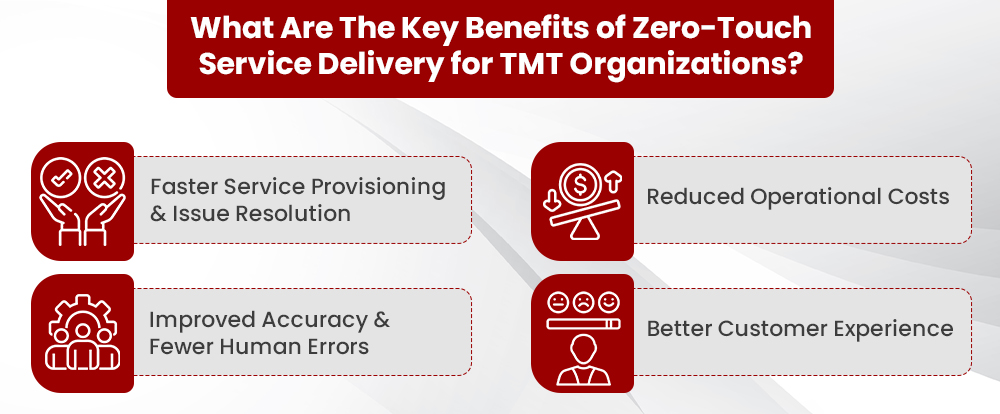
Zero-touch service delivery offers several essential benefits for TMT organizations that need to manage large-scale operations efficiently. By reducing manual effort and enabling faster decision-making, it helps businesses improve service quality, reduce downtime, and create more seamless customer experiences. Some of the major benefits include:
Faster Service Provisioning and Issue Resolution
Zero-touch workflows help TMT enterprises in activating services, process requests, and resolve incidents much faster than traditional manual methods. AI agents can automatically validate requests, assign resources, and complete workflows in minutes rather than hours or days.
Reduced Operational Costs
By automating repetitive tasks like ticket routing, diagnostics, escalations, and customer updates, organization can majorly reduce manual workload and operational costs. This enables the teams to concentrate more on strategic and high-value activities.
Improved Accuracy and Fewer Human Errors
Manual processes usually result in missed steps, incorrect data entry, and delayed responses. AI-driven workflows offered by inMorphis follow predefined logic and make use of real-time data to make decisions, reducing the risk of human error.
Better Customer Experience
Customers expect prompt responses, uninterrupted services, and real-time updates. Zero-touch service delivery enhances customer satisfaction by offering faster assistance, proactive communication, and minimal service disruption.
All of these benefits help enterprises stay competitive in an industry where customers expect fast, smooth, and uninterrupted digital experiences. The telecom companies are already witnessing measurable outcomes from AI-driven service management. Also, businesses that are using ServiceNow AI agents have reported faster case resolution, better network performance, and enhanced service availability.
The Future of Autonomous TMT Operations
Autonomous operations are slowly becoming the future of the TMT industry. As 5G, IoT, edge computing, and connected devices continue to expand, businesses will require intelligent systems that can manage rising complexity in real time. Organizations that continue to depend on manual processes may struggle to keep up with rising service demands and customer expectations.
With ServiceNow Agentic AI, ServiceNow GenAI, and AIOps platform capabilities, TMT organizations can create faster, smarter, and more resilient service operations. As a result, zero-touch service delivery is no longer a future concept, it is already becoming a competitive benefit in 2026 and the years ahead.
Ready to modernize your TMT operations? Contact us today and explore how ServiceNow Agentic AI services by inMorphis can help you offer seamless, AI-driven service experiences at scale.
