Many IT enterprises continue to struggle with a gap between their development and operations teams, even after adopting CI/CD practices. While development teams have embraced CI/CD and test automation, IT operations often remain siloed and manual. This disconnect slows change approvals, delays incident response, and creates inconsistencies across environments.
To bridge this gap, enterprises need a solution that not just automates code deployment but also governs and automates the entire ecosystem, from infrastructure provisioning to security enforcement. That’s where ServiceNow DevOps comes in.
In this blog post, we will talk about the problems faced by the enterprises, its solution and why IT businesses need ServiceNow DevOps to get maximum RoI after adopting CI/CD practices.
What Makes ServiceNow DevOps Critical for Full-Stack IT Automation?
In most enterprises, automation is heavily focused on the CI/CD pipeline. Activities like building code, running unit tests, and deploying applications are streamlined using tools. However, automation rarely extends beyond this stage.
Once the application is deployed, post-deployment operations, such as provisioning infrastructure, applying security patches, updating configurations, and resolving incidents, are still handled manually or via fragmented tools outside the DevOps ecosystem which means:
- Infrastructure provisioning is not codified in the pipeline, relying on tickets or ad-hoc scripts.
- Patching and configuration management lack automation, causing drift and exposing systems to risk.
- Change approvals are manual and not integrated with CI/CD, slowing down delivery.
- Compliance enforcement and audit logging are afterthoughts, disconnected from runtime environments.
This leads to:
- Slow change cycles due to disconnected processes.
- Higher MTTR, as ops teams lack automation and visibility.
- Non-compliance risks, including untracked shadow infrastructure.
- Inefficient operations, with siloed tools and manual handoffs.
Traditional DevOps improves application delivery but fails to automate IT operations end-to-end. Without extending automation into infrastructure, compliance, and incident response, IT businesses struggle to achieve true agility, resilience, and governance at scale.
What is ServiceNow DevOps?
ServiceNow DevOps is a unified platform that integrates development and operations to streamline and automate the entire software delivery process. It acts as a central environment where enterprises can connect their existing DevOps tools, such as planning, code repositories, build pipelines, and deployment systems with ServiceNow’s powerful workflow and automation capabilities.
Why ServiceNow DevOps Is Essential After CI/CD Adoption?
ServiceNow DevOps bridges the gap between development pipelines and IT operations by embedding automation, governance, and compliance directly into DevOps workflows. It acts as a control plane that unifies toolchains, standardizes change processes, and enforces policy across the SDLC and operational lifecycle.
CI/CD Pipeline Integration
ServiceNow provides native integration with leading CI/CD tools such as Jenkins, GitHub, GitLab, and Azure DevOps, acting as a bridge between development pipelines and IT operations. This integration ensures traceability, governance, and real-time visibility, without slowing down the delivery speed developers expect. The key capabilities include:
- Pipeline event capture: Automatically listens for build, test, and deployment events across CI/CD tools.
- Change automation: Triggers and links change requests from pipeline activities, eliminating manual interventions.
- End-to-end traceability: Associates pipeline events directly with change records to maintain compliance and audit readiness.
- Real-time dashboards: Offers live status, deployment progress, and risk-level insights to all stakeholders.
Automated Change Management
ServiceNow automates the full change lifecycle based on DevOps pipeline triggers.
- Each deployment is converted into a change record, enriched with metadata and dynamically risk scored.
- Low-risk or standard changes are auto-approved based on pre-defined policies.
- The platform updates the CMDB in real time to maintain an accurate system state and support downstream impact analysis.
Embedded Governance and Compliance
Governance is built into every stage of the delivery pipeline that helps enterprises reduce risk, enforce standards, and simplify audits without slowing down innovation. The key features include:
- Automated audit logging: Generate and attach audit trails to change records automatically for traceability and audit readiness.
- Policy-as-code enforcement: Apply security, access, and deployment policies programmatically across your DevOps toolchain.
- Real-time compliance visibility: Leverage integration with ServiceNow GRC modules to enable continuous control monitoring and up-to-date compliance status.
Integration Hub for Cross-Platform Orchestration
ServiceNow’s Integration Hub acts as the engine for orchestrating complex, cross-platform IT operations. By connecting infrastructure, cloud, and monitoring tools, it enables seamless automation across the entire IT ecosystem. Key capabilities include:
- Broad toolchain integration: Connect with Terraform, Ansible, AWS, Azure, and popular monitoring platforms.
- End-to-end workflow orchestration: Trigger multi-step operational processes such as provisioning, patching, scaling, and rollbacks from a unified interface.
- Event-driven automation: Initiate workflows based on alerts, CI/CD pipeline events, or scheduled tasks which support proactive incident management and self-healing systems.
With Integration Hub, IT businesses reduce manual effort and operational overhead while enabling responsive, automated service delivery across their infrastructure.
Also, read Top 5 Must Have ServiceNow Developer Skills
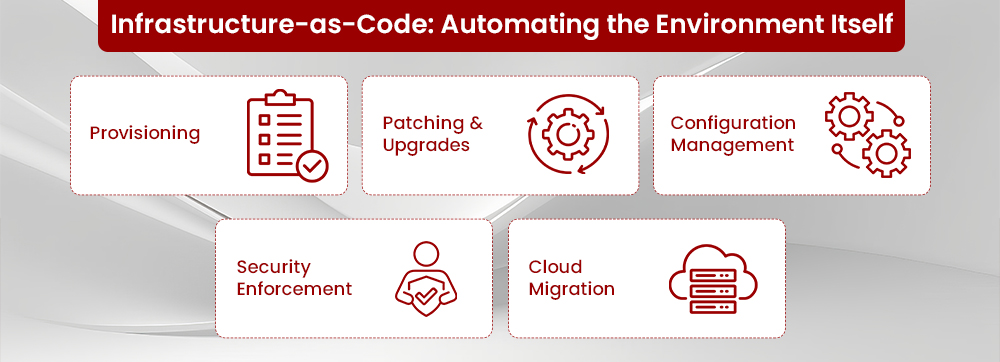
Infrastructure-as-Code: Automating the Environment Itself
When combined with Infrastructure-as-Code1 (IaC) tools like Terraform and Ansible, ServiceNow DevOps extends automation to infrastructure provisioning, patching, and configuration management.
1. Provisioning:
- Use Terraform to provision servers, containers, and networks.
- Trigger infrastructure deployments on-demand or via self-service catalogs.
2. Patching and Upgrades:
- Use Ansible to automate OS and kernel patching.
- Schedule and enforce patching based on risk policies.
3. Configuration Management:
- Define desired infrastructure state declaratively.
- Eliminate configuration drift across environments.
4. Security Enforcement:
- Rotate credentials, update certificates, and automate remediation.
- Integrate vulnerability scanners to trigger patch playbooks.
5. Cloud Migration:
- Replicate on-premises setups using reusable IaC modules.
- Automate validation, enforce approval gates, and enable rollback for safer transitions.
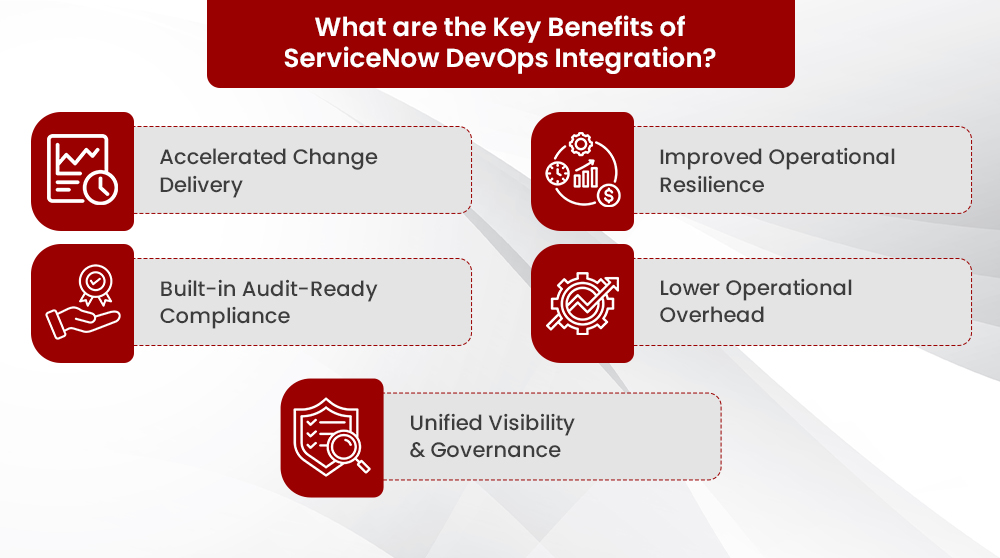
What are the Key Benefits of ServiceNow DevOps Integration?
A unified automation approach that combines CI/CD integration, governance, and orchestration enables enterprises to modernize IT operations while driving measurable outcomes across speed, resilience, compliance, and efficiency.
1. Accelerated Change Delivery
Automation reduces friction in the deployment pipeline. By eliminating manual approvals and provisioning delays, teams can move faster while still maintaining control.
- Reduce lead time for changes with automated workflows.
- Align releases with business priorities using dynamic risk scoring.
2. Improved Operational Resilience
When systems are designed to detect and respond automatically, downtime becomes rare, and recovery becomes faster. Integration Hub enables this by powering self-healing and scalable infrastructure.
- Auto-remediate incidents with event-driven workflows.
- Enable high availability with automated failovers and scaling mechanisms.
3. Built-in Audit-Ready Compliance
With compliance controls embedded in delivery pipelines, enterprises stay secure and audit-ready by default.
- Track every change, deployment, and remediation automatically.
- Enforce patching, access control, and security policies through policy-as-code.
4. Lower Operational Overhead
By offloading repetitive, low-value tasks to automation, teams reclaim time to focus on strategic priorities like innovation and continuous improvement.
- Eliminate manual tasks such as ticket updates, server setup, and patch tracking.
- Reduce context switching and firefighting for engineering teams.
5. Unified Visibility and Governance
A single platform for managing change, infrastructure, compliance, and incidents allows leaders to make informed decisions and respond to risks in real time.
- Centralize oversight across DevOps, Security, and GRC functions.
- Gain real-time dashboards to track performance, risk, and compliance metrics.
Through this approach, IT not only becomes more efficient but also better aligned with the pace and priorities of the business.
Conclusion
CI/CD has improved development speed, but without automating operations, provisioning, and compliance, most enterprises still face delays, risks, and inefficiencies. ServiceNow DevOps closes this gap by connecting DevOps pipelines with IT operations, enabling end-to-end automation across infrastructure, change management, and governance.
Paired with Infrastructure-as-Code and Integration Hub, it allows enterprises to automate provisioning, enforce policies, and respond to incidents in real time. This unified approach reduces manual effort, strengthens compliance, and improves resilience by delivering the full value of DevOps at enterprise scale.
Looking to maximize your DevOps investment? inMorphis, a ServiceNow invested partner, can help you architect and implement a secure, scalable DevOps automation framework using ServiceNow. Contact us to improve your journey toward full-stack IT automation and higher RoI.
