Operational Technology (OT) — the industrial control systems, PLCs, SCADA networks, and field devices that keep factories, utilities, transport, and critical infrastructure running — is no longer a separate, dark corner of enterprise IT. Today, OT is the business unit in itself.
Reports that ransomware attacks on OT systems rose from 32% in 2023 to 56% in 2024, highlights the new risks that come with digital transformations in OT.1 Attacks that disrupt OT may cause real-world safety, environmental, and economic consequences, and in 2026, defending it will be a board-level responsibility.
This blog slices through the noise and lays out the five OT security trends defenders must prioritize this year, with practical implications and recommended actions.
Why Operational Technology (OT) Security Will be Critical in 2026?
Operational Technology environments are legacy-heavy, highly distributed, and often designed for reliability and availability rather than confidentiality or patchability. As organizations pursue digitization and remote operations, previously air-gapped systems are exposed through IT integration, third-party services, and cloud-enabled operational tooling.
The result: an expanding attack surface where fast-moving adversaries — from criminal ransomware gangs to nation-state actors — can cause physical disruption. The urgency is not hypothetical: recent industry studies and incident reporting show a clear escalation in OT-targeted ransomware and geopolitically driven campaigns.
Top 5 Operational Technology Security Trends
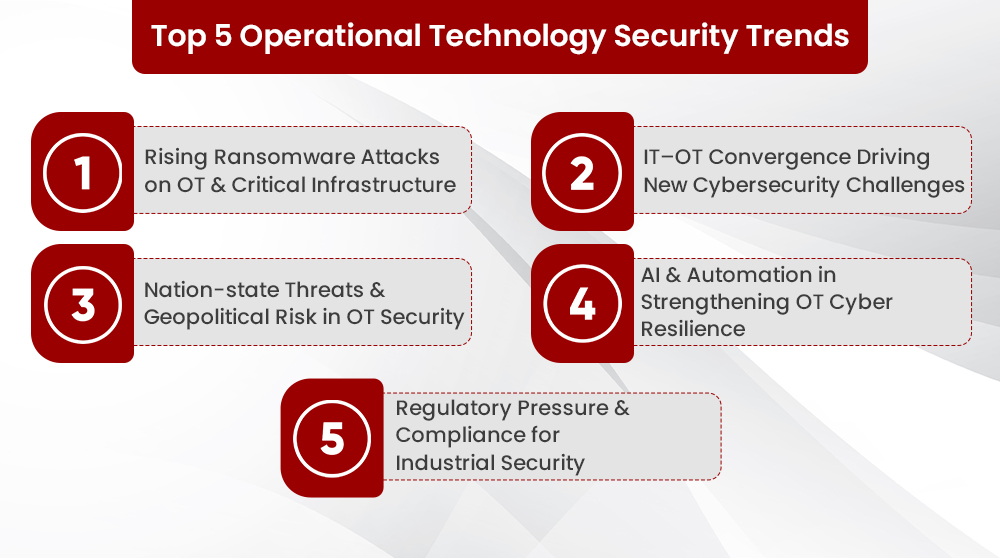
Trend 1: Rising Ransomware Attacks on OT and Critical Infrastructure
Ransomware continues to evolve beyond encrypted file servers into carefully staged campaigns that attack safety systems, shut down production lines, and hold industrial processes hostage.
Ransomware actors are increasingly adapting OT-specific tactics — reconnaissance of ICS protocols, targeted manipulation of controllers, and extended dwell time to maximize operational impact. Defenders should assume the next disruptive outage will be ransomware-driven and prepare accordingly.
Actions Required: Implement network segmentation that enforces strict IT–OT boundary controls; adopt immutable backups and recovery playbooks tested in realistic OT scenarios; enforce least-privilege access for engineering workstations; and practice incident response tabletop exercises that include safety and operations teams.
Trend 2: IT–OT Convergence Driving New Cybersecurity Challenges
Digital transformation and Industry 4.0 initiatives have accelerated IT–OT convergence: cloud analytics, remote management, digital twins, and vendor remote access are mainstream.
While convergence unlocks productivity, it also merges two ecosystems with different assumptions, toolsets, and risks. OT assets often lack modern identity, visibility, and patching mechanisms that IT expects, creating blind spots that attackers exploit.
Actions Required: Treat IT–OT integration as an engineering program, not a networking project. That means shared governance, joint incident response, standardized asset inventories, and unified observability tools that understand OT protocols. Adopt asset discovery and monitoring solutions designed for industrial environments and align change-control processes across teams.
Trend 3: Nation-state Threats and Geopolitical Risk in OT Security
Geopolitical tensions are pushing state-affiliated actors and sophisticated proxies to target critical infrastructure as a strategic lever. These operations are often measured, multi-stage, and designed to persist or degrade capability rather than loudly ransom. The result: defenders must plan for adversaries that have time, resources, and operational intent to cause physical harm or long-term disruption.
Actions Required: Prioritize threat-hunting and long-term telemetry retention for OT environments, apply adversary-based threat models, and cultivate violence-of-effect planning with executive and legal stakeholders. Strengthen intelligence-sharing with sector CERTs and government agencies, and ensure contracts with vendors include security SLAs and transparency clauses.
Also, read What is the difference between OT & IT?
Trend 4: AI and Automation in Strengthening OT Cyber Resilience
Artificial intelligence and automation are changing both sides of the OT security ledger. Attackers utilize automation to scale phishing, reconnaissance, and exploitation pipelines; defenders employ AI-driven anomaly detection, predictive maintenance, and telemetry analysis, along with automated playbooks, to bridge the people-machine gap in incident response. Properly applied, ML can detect subtle deviations in control loops or device behavior that human operators would miss. 2
Actions Required: Adopt pragmatic AI, start with narrow, interpretable models focused on high-signal telemetry (e.g., command sequences, process variables) and pair automated detection with human-in-the-loop validation. Invest in integration between detection systems and OT change-control so alerts can trigger safe, automated mitigations (e.g., isolating a cell) while preserving forensic data. Emphasize model governance, adversarial testing, and robust data pipelines to avoid automation surprises.
Trend 5: Regulatory Pressure and Compliance for Industrial Security
Regulatory bodies globally are stepping up with directives and enforcement that directly affect OT operators. In Europe, NIS2 and related rules force higher-risk entities to adopt stronger governance, reporting, and risk-management practices. Standards such as IEC 62443 are being mapped to these legal requirements, making compliance both a legal necessity and a practical framework for reducing risk.
Actions Required: Map regulatory requirements to technical controls (identity, logging, patching, segmentation) using IEC 62443 and other standards as the bridge. Build compliance as an operational capability, centralizing evidence collection, automating attestation where possible, and embedding security requirements into procurement and contractor management. Remember: compliance is a floor, not a ceiling, aim for resilience above and beyond checkboxes.
Conclusion: What OT Resilience Looks Like in 2026?
Industrial cyber resilience in OT in 2026 is not a one-time project; it’s an operational discipline. It combines engineering rigor (segmentation, redundancy, and change control), modern detection (AI-assisted telemetry and threat hunting), cross-domain collaboration (IT, OT, legal, and safety), and precise regulatory alignment. Organizations that blend these elements will not only survive disruptions, they’ll preserve safety, protect revenue, and gain the operational confidence to digitize further
Secure your Operational Technology now with inMorphis. If you are planning to take the first step toward resilient and compliant OT security, contact us now.
