What is a Value Realization Framework?
Enterprises aim to become a digital-first organization by making investments in new platforms, digital transformation programs, acquisitions, and restructuring. Each of these initiatives begins with a future-looking perspective: this will create value.
But the real challenge surfaces when the time to prove that value comes; many leaders are left with half-answers. They can show that money was spent, systems were deployed, or teams were reorganized, but they struggle to connect those actions to measurable outcomes.
That’s where the Value Realization Framework comes into play.
It provides both strategic direction and operational tracking by asking: What kind of value are we aiming for? And it holds the organization accountable by demanding proof: How do we know we actually get there?
At its core, the value realization framework does four things:
- Defines what “value” really means for your enterprise.
- Establishes a baseline to measure improvements.
- Tracks progress with credible evidence.
- Embeds a habit of continuous improvement so value compounds over time.
With the value realization framework implemented, instead of showcasing activities, “we rolled out a new ERP system,” enterprises can showcase outcomes: “order-to-cash time dropped 22% and working capital improved by 28%.”
And in a world where executives, boards, and investors want proof rather than promises, that distinction makes all the difference, ensuring accountability and transparency.
This blog discusses what the value realization framework is, why it matters, and what the four steps are to establish enterprise value delivery proof at your organization.
Why Value Realization Framework Matters?
Let’s be blunt: in today’s environment, “we implemented it” isn’t enough. Executives, boards, and investors expect to see precisely how each initiative contributes to business success.
In outcome-driven scenarios, the value realization framework becomes crucial because it:
- Measurably connects initiatives to strategy.
- Builds trust by showing clear evidence of outcomes.
- Protects ROI by continual improvements, filling the post-implementation gaps.
- Increases agility by highlighting where to shift focus as conditions change.
- Reinforces a culture where outcomes, not activities, are the accurate measure of progress.
Without this kind of framework, companies risk working hard but failing to prove they’re working smart.
The 4 Steps to Enterprise Value Delivery Proof
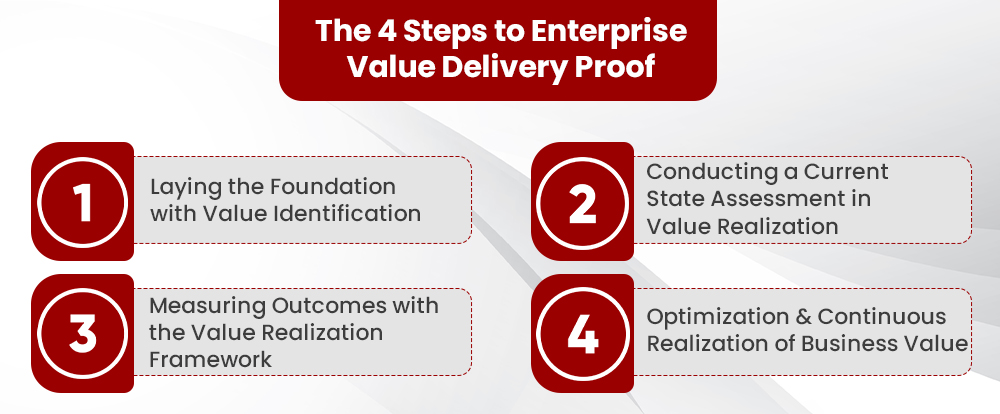
The framework works best when followed as a cycle. Let’s break it down into four steps.
Step 1: Laying the Foundation with Value Identification
The first step is deceptively simple but often overlooked: decide what value actually mean.
For some enterprises, value is strictly financial - boosting revenue, improving margins, or cutting costs. For others, it may be operational - reducing delays, improving quality, or scaling faster. And in specific sectors, value could mean something less tangible but no less critical, such as compliance, employee well-being, or customer trust.
How to identify what business-outcome-driven value means for you:
- Invite voices from across the business. Finance, operations, IT, HR, and customer-facing teams will each define value in their own unique ways.
- Link outcomes back to the big picture. For e.g., if the strategy is global expansion, then value probably includes scalability, agility, and local compliance.
- Put expectations in writing. A clear “value hypothesis” (e.g., “this CRM implementation will improve lead conversion by 10% within 12 months”) forces precision.
Example: A healthcare provider introducing telemedicine might not define value as simply “launching an app.” Instead, the real value is shorter patient wait times, increased access in underserved areas, and reduced costs for both patients and staff.
By starting here, leaders prevent a common pitfall: launching initiatives without clarity on what success actually looks like.
Also, read How KPIs Drive Value Realization Framework?
Step 2: Conducting a Current State Assessment in Value Realization
Once the value is defined, the next question is: Where are we today?
This is the current state assessment. It’s essentially the “before” picture - without it, no “after” picture will carry weight.
You can assess your current business state:
- Mapping processes to spot inefficiencies and bottlenecks.
- Collecting baseline metrics - cycle times, error rates, costs, uptime, satisfaction scores.
- Benchmarking against peers to reveal gaps.
- Surfacing risks or constraints that might block improvement.
Here’s why it matters. Imagine a logistics company adopts AI to optimize delivery routes. Without measuring current fuel consumption, delivery times, and missed deadlines, the company will have no way of proving improvements later. Executives will have to take it on faith, which rarely works when millions are at stake.
This step builds credibility. Leaders don’t have to argue whether something improved because they’ve got the evidence right in front of them.
Step 3: Measuring Outcomes with the Value Realization Framework
This is where the rubber meets the road: measuring outcomes.
Once initiatives are in motion, leaders need to track whether promised value is actually showing up. And not six months too late, measurement needs to be ongoing, visible, and tied back to strategy.
Practical ways to measure business value through a curated value realization framework:
- Define SMART KPIs (Specific, Measurable, Achievable, Relevant, Time-bound).
- Track both leading indicators (early signs of progress like adoption rates) and lagging indicators (end results like revenue growth).
- Automate dashboards so the correct data reaches the right people in real time.
- Schedule reviews where data isn’t just shown but interpreted—what does it mean, and what action should follow?
Example: In a large-scale ERP upgrade, leading indicators might include employee training completion rates and usage stats. Lagging indicators might reduce reconciliation errors and faster financial close times.
Here’s the key to effective value realization: raw numbers aren’t enough. What executives want is context. Saying “we improved efficiency by 12%” isn’t as powerful as saying, “efficiency gains freed up 2,000 staff hours last quarter, equivalent to $1.5M in savings.” Numbers plus story is equal to proof.
Step 4: Optimization and Continuous Realization of Business Value
A lot of enterprises stop here; they measure, show results, and move on. But that leaves value behind on the table. The best companies treat value realization not as a box to check but as a continuous cycle.
Markets change. Technology shifts. Customer expectations rise. A framework that isn’t updated becomes stale. Continuous optimization ensures value grows rather than fades.
How to embed a continuous improvement mindset:
- Revisit KPIs regularly to ensure they still align with strategy.
- Use results to refine processes and strip out waste.
- Expand what “value” means. An initiative that started as cost-cutting might later reveal sustainability or employee engagement benefits.
- Share wins widely to keep teams engaged and reinforce the culture of accountability.
Example: A manufacturer using predictive analytics to reduce downtime might later realize the same data can optimize energy usage and improve workplace safety. What began as a cost-saving project evolves into a broader source of value.
The organizations that thrive in uncertain times aren’t those with one-time wins; they’re the ones that keep adapting and proving value year after year.
Conclusion
Proving value isn’t easy, but it’s no longer optional. The value realization framework gives enterprises a disciplined, repeatable way to connect investments with outcomes that matter.
The path is straightforward:
- Identify what value means.
- Capture the current state.
- Measure outcomes with discipline.
- Optimize continually.
Follow these steps, and you stop debating whether something worked, you’ll have the proof. More importantly, you’ll build credibility that extends beyond a single project to the entire enterprise.
In a marketplace defined by disruption, organizations that can demonstrate value consistently will outlast those that can’t. The message for leaders is clear: stop reporting effort. Start reporting impact. The value realization framework is your playbook for making that shift. Partner with inMorphis today to unlock enterprise-wide value and show proof that truly matters.
