
Are you struggling to find the right offshore service provider for your IT business? Or do you worry about aligning your outsourcing partner with your business goals, ensuring data security, or managing teams across time zones and cultures? You’re not alone.
As enterprises undergo digital transformation and seek to optimize costs, offshore services have become a preferred option. They enable businesses to access domain-specific skills, maintain continuous operations, and cut costs by utilizing a distributed global workforce. However, selecting a reliable offshore partner can be challenging, things like governance, compliance, operational inefficiency, inconsistent performance standards, and many more.
In this blog, we’ll break down what offshore services are, why they matter in 2025, and how you can turn outsourcing from a cost-saving tactic into successful business transformation.
What are Offshore Services?
Offshore services refer to business activities or functions that are performed in a country other than where the company is headquartered or where the primary market is located. This typically involves hiring third-party providers or establishing company operations in foreign countries to handle specific tasks or processes, where labor and operational costs are lower. It helps enterprises to reduce costs, improve efficiency, and gain access to specialized skills through a globally distributed workforce.
Offshore services are important because they:
- Minimize the operational cost of IT environments.
- Provide access to a diverse and scalable workforce.
- Support faster digital transformation through specialized capabilities.
What are the Benefits of Outsourcing for IT Businesses?
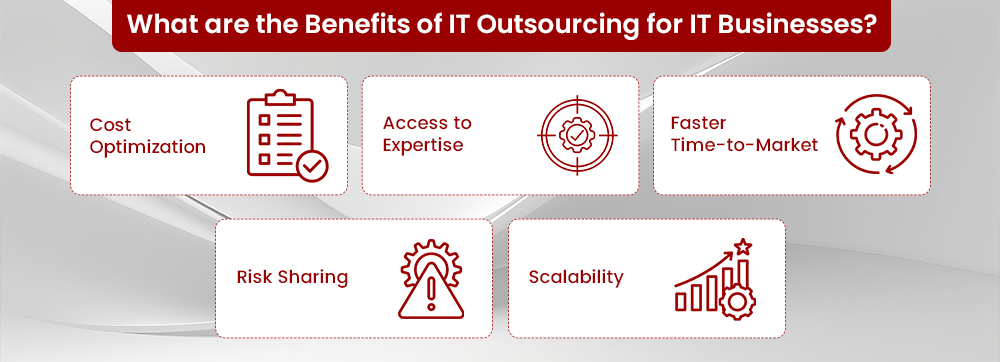
Before diving deeper into specific offshore models, it’s important to understand the broader business value that IT outsourcing brings to the table. IT outsourcing offers several key benefits, such as:
- Cost Optimization: Outsourcing reduces hiring, training, and infrastructure costs by leveraging lower-cost geographies.
- Access to Expertise: Businesses gain instant access to highly skilled engineers, architects, and analysts who specialize in technologies like ServiceNow, AI, DevOps, and cloud.
- Faster Time-to-Market: With distributed teams working across time zones, development and deployment cycles are shortened.
- Risk Sharing: Vendors take on operational and compliance risks, especially when SLAs and governance models are in place.
- Scalability: Easily expand or reduce team size based on business needs without long-term overhead.
What are the Key Benefits of Offshore Services?
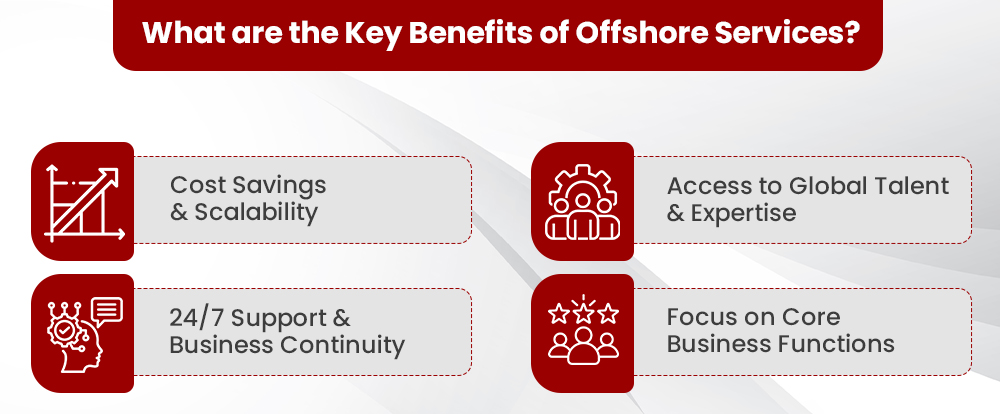
While cost remains a major factor, offshore services provide far more than just financial savings. It offers specific advantages that help businesses grow, work faster, and stay flexible across different locations.
Cost Savings and Scalability
- Offshore vendors in lower-cost economies allow up to 70% reduction in labor and infrastructure costs1.
- Enterprises gain the flexibility to adjust team size on demand, with minimal administrative effort.
- They offer flexible engagement models that adapt to changing project scope and priorities.
Access to Global Talent and Expertise
- Offshore regions have deep talent pools across cloud computing, ServiceNow, cybersecurity, AI, and more.
- Teams are trained and certified on enterprise platforms, offering a high degree of specialization.
- Clients gain access to cross-functional teams with proven delivery experience in regulated and complex environments.
24/7 Support and Business Continuity
- Offshore teams ensure uninterrupted operations by covering non-working hours in the client’s time zone.
- A follow-the-sun model allows continuous monitoring, issue resolution, and development progress.
- This structure helps mitigate local disruptions and maintain service availability.
Also, read 5 Benefits of Business Continuity Management
Focus on Core Business Functions
- By outsourcing infrastructure, support, and platform maintenance, internal teams can focus on customer experience, innovation, and strategic initiatives.
- It manages backend complexity so that your team can focus on front-end impact.
How to Choose the Right Offshore ServiceNow Services Provider?
Choosing the right offshore services provider is critical to realizing long-term value from your outsourcing strategy. Your partner should be able to align with your technology roadmap, adapt to evolving business needs, and uphold strong governance and compliance standards. Here is a list of how to evaluate your offshore vendor.
Points to Remember for Evaluating Offshore Vendors:
- Technical Capability: Does the provider specialize in platforms like ServiceNow, and can they scale across modules and business functions? Evaluate service provider’s specialization in ServiceNow through partner finder and their scalability capabilities across modules and business functions.
- Certifications and Standards: Look for ISO, SOC2, and platform-specific certifications.
- Delivery Maturity: Assess project management models, resource onboarding, and Delivery SLAs.
- Security and Compliance: Understand their policies around data protection, IP rights, and legal frameworks.
- Communication Frameworks: Ensure clear escalation paths, governance models, and collaborative toolchains are in place.
Also, read 9 Tips to Choose the Best ServiceNow Partner
Top Countries for Offshore IT Services in 2025
Once you’ve defined your evaluation criteria, the next step is selecting the right geography. Each region brings its own strengths, from cost and talent availability to time zone advantages and regulatory alignment. Here’s a look at the leading offshore destinations in 2025:
India2
India remains one of the most mature and versatile offshore IT markets in the world.
- Talent Pool: A broad and skilled workforce, including certified experts across platforms such as ServiceNow, Microsoft Azure, AWS, and Salesforce.
- Technical Strengths: Strong capabilities in application development, cloud engineering, cybersecurity, and enterprise platform support.
- Delivery Maturity: Well-established governance models, agile practices, and process certifications (e.g., ISO 27001, CMMI Level 5).
- Language Proficiency: English is widely spoken and used as the primary business language in most IT delivery centers.
- Use Case Alignment: Ideal for end-to-end service delivery, including software development, platform engineering, and support operations.
Philippines2
The Philippines is a preferred destination for IT-enabled services, particularly those requiring strong communication skills and business process alignment.
- Service Strengths: IT support, service desk, customer service, and back-office operations.
- Language and Cultural Fit: High English fluency and a Western-aligned work culture.
- Cost Competitiveness: Lower labor costs for support and operations functions.
- Growing IT Capabilities: Emerging focus on infrastructure support, low-code platforms, and cybersecurity.
Eastern Europe3
The Eastern Europe region offers a strong blend of technical expertise, regulatory alignment, and geographic convenience.
- Talent and Skills: Home to a large pool of engineers skilled in software development, enterprise platforms, DevOps, and emerging technologies like RPA and AI.
- Compliance Alignment: As part of the EU, countries in this region follow GDPR and other European data protection regulations, making it a strong choice for privacy-sensitive workloads.
- Time Zone Compatibility: Minimal time difference with Western Europe allows for real-time collaboration and agile delivery cycles.
- Cost and Infrastructure: While not as low-cost as Asia, the region offers competitive rates, reliable digital infrastructure, and a stable business environment.
- Typical Use Cases: Well-suited for product development, application modernization, and nearshore support services for European clients.
Legal and Compliance Considerations for Offshore IT Services
Offshore IT services involve working across legal jurisdictions, handling sensitive data, and interacting with systems that are often subject to strict compliance requirements. To ensure risk mitigation and regulatory alignment, enterprises need to put clear legal frameworks in place and assess their vendors accordingly. Key legal and regulatory focus areas are:
- Data protection and privacy remain top priorities. Vendors must comply with regional laws such as the General Data Protection Regulation (GDPR), the California Consumer Privacy Act (CCPA), or HIPAA in the healthcare domain. Enterprises should verify that offshore teams use encryption, enforce strict access controls, and comply with data residency requirements where applicable. Cross-border data transfers must be backed by appropriate safeguards, such as Standard Contractual Clauses or equivalent frameworks.
- Intellectual property (IP) ownership should be clearly defined in the contract. This includes source code, documentation, and any custom configurations created during the engagement. Non-disclosure agreements (NDAs) and confidentiality clauses should be standard practice to protect sensitive business information from misuse or leakage.
- Service level agreements (SLAs) help set expectations on key operational parameters like system uptime, incident resolution time, and escalation procedures. Contracts should also specify what happens in case of SLA breaches, including financial penalties or the right to terminate the agreement.
- Security and certification standards must be verified before onboarding a vendor. Look for recognized certifications such as ISO 27001 for information security management or SOC 2 Type II for data handling practices. Vendors should also have an incident response process, access control policies, and periodic audit readiness.
- Jurisdictional risks and export controls must be considered when selecting a delivery location. Certain data types or technologies may be restricted under export regulations like the U.S. Export Administration Regulations (EAR). Additionally, geopolitical risks or sanctions may limit operations in certain regions, so legal teams must evaluate country-specific restrictions.
How to Successfully Implement Offshore IT Services?
Once a provider is selected, the next step is setting up a smooth implementation. This includes team integration, communication planning, and ongoing governance.
Best Practices for Managing Offshore Teams
- Define objectives, SLAs, and delivery milestones clearly.
- Establish structured onboarding processes with platform and security training.
- Use performance dashboards and real-time tracking through platforms like ServiceNow.
Communication and Collaboration
- Set up shared tools for documentation, version control, and task management (e.g., ServiceNow, Jira, Teams).
- Schedule regular syncs during overlapping time zones for better alignment.
- Promote transparency in daily updates, blockers, and sprint planning.
Common Challenges and Solutions
- Cultural Differences: Invest in cross-cultural training and team-building practices.
- Time Zone Delays: Use asynchronous collaboration and align overlapping hours.
- Quality Gaps: Implement code reviews, test automation, and QA gates.
- Misaligned Expectations: Use joint governance and regular business reviews.
Comparing Offshore IT Service Models with Nearshore and Onshore IT Service Model
The outsource models are categorized based on the location of the service provider relative to the client’s business. The most common models include offshore, nearshore, and onshore outsourcing. Below is a comparison between offshore and nearshore models:
|
Criteria |
Offshore |
Nearshore |
Onshore |
|
Cost Efficiency |
Significantly lower labor and delivery costs, especially for long-term projects |
Moderate savings |
Highest cost, minimal savings potential |
|
Talent Scalability |
Access to large, specialized, and diverse talent pools across technologies and domains |
Moderate talent availability |
Limited pool, especially for niche or certified roles |
|
24/7 Global Support |
Continuous operations and faster resolution times |
Limited by regional time zones |
Restricted to business hours unless costs increase |
|
Delivery Capacity |
Ability to manage high-volume delivery for enterprise platforms and IT ops |
Best for mid-sized or collaborative tasks |
Capacity depends on local hiring speed and cost |
|
Technology |
Expertise in platform engineering (e.g., ServiceNow, SAP, DevOps, AIOps) |
Strong in region-specific technologies |
May lack global certifications and scale |
|
Project Cost Flexibility |
Supports T&M, fixed-price, or dedicated models at scale |
Better for agile or short-term work |
Least flexible due to high labor cost |
|
Use Case Fit |
Ideal for platform implementation, modernization, managed services, and DevOps |
Best for regional support and agile sprints |
Best for strategic leadership roles or compliance mandates |
The Future of Offshore IT Services
The offshore services are evolving rapidly, driven by AI, remote work, and cloud-native platforms. Service providers that combine global delivery with intelligent automation will lead to the next wave of transformation. The possible future trends include:
AI and Automation
- AI-assisted testing, incident prediction, and workflow orchestration reduce human error and improve service reliability.
- ServiceNow and GenAI capabilities automate routine IT tasks, enabling teams to focus on innovation.
Cloud and Remote Work
- Cloud-based development environments and remote collaboration tools enable flexible delivery.
- Enterprises are investing in secure, distributed teams that are platform-ready from day one.
- ServiceNow’s cloud-based architecture enables centralized management, no matter where the delivery is happening.
Also, read What are the Latest Trends in Offshoring?
Conclusion
Offshore services have emerged as a solution for innovation, agility, and cost optimization. Today’s offshore models offer high-value capabilities, from enterprise platform support and DevOps to AI-enabled operations and business continuity planning.
However, utilizing the full potential of offshore services requires more than choosing a low-cost vendor. It demands a structured approach to selecting the right geography, aligning with specialized delivery capabilities, and enforcing strong governance, security, and compliance standards. The success of your offshore strategy hinges on how well your provider understands your business objectives, platform roadmap, and operational complexity, and whether they can translate that into scalable, high-quality delivery.
Moreover, with the rise of cloud-native platforms, AI, and remote collaboration tools, the future of offshoring is becoming more intelligent, automated, and seamless. Platforms like ServiceNow enable centralized visibility, agile development, and integrated service management, regardless of where your teams are located. This opens a new world of possibilities for distributed delivery, platform-led operations, and service innovation.
Ultimately, the goal of offshoring is not just to cut costs; it’s to create value. It’s about freeing up internal teams to focus on priorities while tapping into a global network of specialists who can execute with speed, scale, and precision.
At inMorphis, we help enterprises build intelligent offshore delivery models powered by ServiceNow and backed by industry best practices. Connect with our experts for a customized offshore model according to your business needs.
