Which is more damaging to an enterprise: an unplanned audit penalty or ongoing license overspend?
Both inefficiencies stem from weak compliance management. Audit penalties create sudden financial shocks, while ongoing overspend quietly erodes budgets and reduces software ROI.
These risks often arise from misaligned entitlements, fragmented license tracking, and inconsistent usage monitoring. Without centralized visibility, enterprises struggle to reconcile deployments with contracts, leaving them exposed to unnecessary costs and regulatory scrutiny.
Financial exposure, operational inefficiency, and reputational risk increase when compliance is reactive. ServiceNow SAM (Software Asset Management) provides a proactive approach by centralizing license tracking, validating usage, and continuously monitoring compliance, enabling enterprises to stay audit-ready and optimize software investments.
In the next section, we will examine the triggers and scope of software license audits and outline practical steps to build audit-ready processes that minimize financial and operational risk
What Triggers a Software License Audit?
Understanding why and when audits occur is critical for executive decision-making in any enterprise. Software vendors initiate audits to verify license compliance, safeguard revenue, and ensure contractual obligations are met. For enterprises, awareness of these triggers allows leadership to anticipate scrutiny and embed proactive controls.
The most common audit triggers include:
- Irregular Usage Patterns: Sudden spikes in license consumption, unverified deployments, or rapid scaling can attract vendor attention.
- Mergers and Acquisitions: Consolidation of IT environments often reveal inconsistencies in license entitlements and usage.
- Vendor Revenue Assurance Campaigns: Vendors conduct routine audits as part of fiscal compliance and revenue validation processes.
How Can ServiceNow SAM Protect Enterprises from Audit Risks?
Enterprises often struggle to balance software availability with compliance obligations. ServiceNow SAM addresses this challenge by combining discovery, license reconciliation, and compliance automation in a single platform. It aligns software governance with broader IT workflows, ensuring that compliance becomes part of daily operations rather than a reactive exercise.
What are the Core Features of ServiceNow SAM?
ServiceNow SAM provides end-to-end visibility and control over software assets through:
- Centralized Asset Discovery and Inventory Management: Consolidates entitlement data and actual usage across on-premises, SaaS (add-on capability), and hybrid environments.
- Automated License Compliance Tracking: Continuously reconciles entitlements with deployments, ensuring ongoing compliance posture monitoring.
- Integration with ITSM and ITOM Processes: Connects with incident, change, and operations workflows to ensure license compliance is maintained during provisioning and system changes.
What are the Key Benefits of ServiceNow SAM?
Enterprises using ServiceNow SAM gain measurable value in both cost and risk management:
- Real-time visibility into entitlements vs. consumption to reduce blind spots.
- Automated compliance reporting and alerting to detect gaps before vendor audits.
- Cost optimization through usage analytics to help reclaim unused or underutilized licenses.
- Risk reduction by proactively managing entitlements, avoiding audit penalties, and unplanned spending.
Building Audit Readiness with ServiceNow SAM: Preparation to Execution
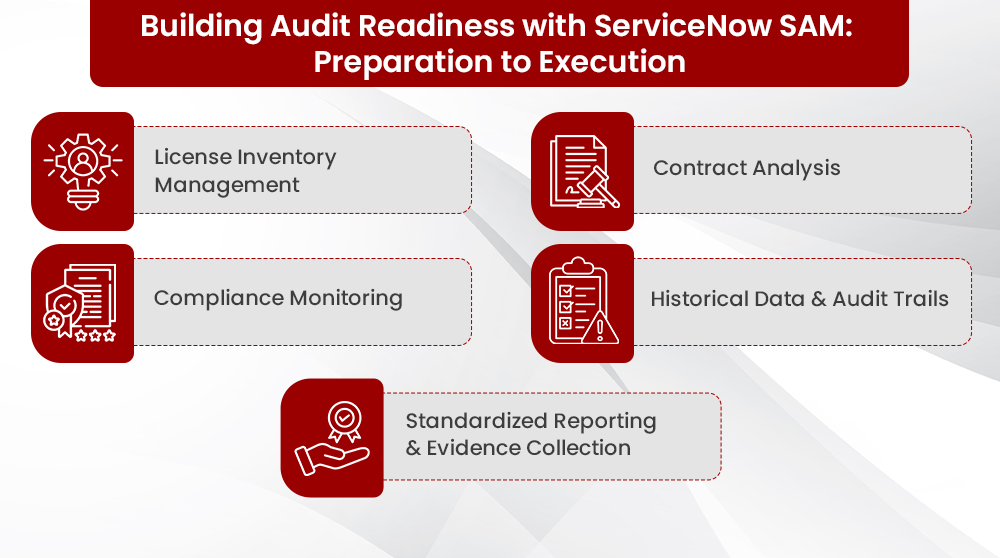
Being audit-ready requires embedding compliance discipline into daily operations. ServiceNow SAM provides a structured approach to both preparation and active audit response by offering:
- License Inventory Management: Maintain comprehensive entitlement records, automate reconciliation with deployed usage, track license lifecycle stages, and generate audit-ready reports with minimal manual effort.
- Contract Analysis: Interpret complex licensing terms, verify mobility rights, manage outsourcing restrictions, and ensure compliance with geographic licensing rules.
- Compliance Monitoring: Automate routine compliance checks, schedule dashboards for ongoing visibility, track renewals, and flag potential exceptions before they escalate.
- Historical Data and Audit Trails: Retain detailed usage records and entitlement logs to enable retrospective validation and support audit queries.
- Standardized Reporting and Evidence Collection: Generate vendor-ready reports quickly and automatically gather proof of purchase, entitlements, and usage data to streamline auditor interactions.
By integrating these capabilities into daily operations, ServiceNow SAM transforms audits from disruptive events into controlled, predictable processes while reducing financial and operational risk.
What Are the Key Steps for Audit Response with ServiceNow SAM?
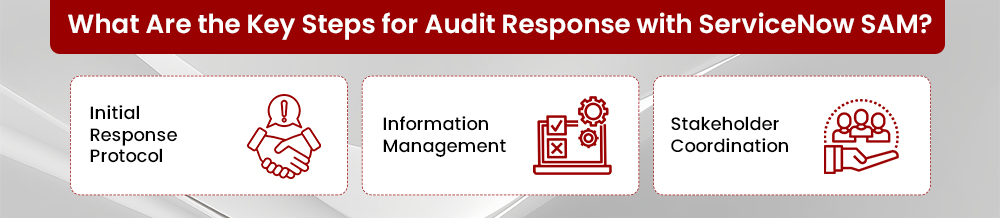
Even with preparation, how an enterprise responds during the audit process determines the outcome. A poorly managed response can lead to over-disclosure, misinterpretation of data, or delays that frustrate auditors. ServiceNow SAM empowers enterprises to control data sharing, streamline communication, and maintain audit consistency.
1. Initial Response Protocol
The first step after receiving an audit notice is to establish a structured response framework. ServiceNow SAM helps enterprises move quickly without losing control.
- Centralized Data Extraction: Generate entitlement and usage reports directly from SAM, avoiding scattered manual collections.
- Response Timelines: Align with vendor deadlines by using automated reporting capabilities.
- Internal Coordination: SAM supports SPOC-led audit coordination by providing a single source of truth.
2. Information Management
One of the biggest risks during an audit is providing excessive or irrelevant information that auditors can use against the enterprise. ServiceNow SAM ensures data is curated and accurate by following ways:
- Controlled Disclosures: Share only normalized entitlement and usage data, avoiding raw datasets that may cause misinterpretation.
- Gap Validation: Use SAM’s compliance reports to pre-identify potential discrepancies before auditors highlight them.
- Audit Request Mapping: Cross-check auditor requests against ServiceNow’s data models to confirm validity and scope.
3. Stakeholder Coordination
Audits are multidisciplinary efforts requiring input from IT, procurement, legal, and compliance teams. ServiceNow SAM provides a single source of truth to align stakeholders by the following ways:
- Legal Involvement: Ensure audit clauses and licensing terms are validated before agreeing to data requests.
- Procurement Alignment: Use SAM entitlement records to verify purchase histories and renewals.
- IT Coordination: Link usage data from discovery tools and CMDB to ensure accurate reporting.
- Executive Reporting: Leverage ServiceNow dashboards to keep leadership informed of audit progress and risks.
How Can ServiceNow SAM Reduce Operational Audit Risks?
Operational audit risks often stem from reliance on individual knowledge or manual, error-prone processes. ServiceNow SAM mitigates these risks by embedding governance, automation, and integrated visibility across the enterprise:
- System-driven Workflows: Role-based dashboards, embedded knowledge, and detailed audit trails ensure continuity even if key personnel transition or leave.
- Automated Compliance Insights: Real-time monitoring, exception alerts, and instant compliance reporting reduce manual errors and streamline audit response.
- Integrated Visibility: Linking software usage to the CMDB, tracking hybrid and SaaS applications, and managing mobility rights closes compliance gaps across complex, multi-cloud environments.
By combining people, process, and technology controls, ServiceNow SAM minimizes operational vulnerabilities and ensures enterprises maintain audit readiness without disruption.
What Should Enterprises do After a Software Audit?
Completing a software audit should trigger continuous compliance improvements. ServiceNow SAM streamlines this phase with remediation, process enhancements, and proactive monitoring.
1. Remediation Planning
- Identify gaps between entitlements and usage.
- Reallocate licenses to reduce true-up costs.
- Automate shortfall analysis for accurate vendor negotiations.
2. Process Improvements
- Automated entitlement uploads to reduce manual errors.
- Integrated discovery for continuous visibility of deployments.
- Regular internal audits using ServiceNow compliance dashboards.
3. Ongoing Compliance Maintenance
- Real-time dashboards to track usage vs. entitlements.
- Renewal alerts to prevent contract lapses.
- Optimization insights to reclaim shelfware and reduce spend.
Conclusion
Software license audits are unavoidable, but operational disruption can be minimized. ServiceNow SAM centralizes asset visibility, automates entitlement reconciliation, and continuously monitors compliance across on-premises, SaaS (add-on capability), and hybrid environments.
Enterprises can reduce financial exposure, prevent audit penalties, and optimize software spending. SAM also enforces governance, aligns IT and procurement workflows, and provides actionable insights to reclaim underutilized licenses.
inMorphis, an invested ServiceNow partner, enables IT enterprises to implement and optimize SAM, ensuring continuous audit readiness, risk mitigation, and cost optimization. Contact our experts to strengthen compliance and maximize software ROI.
